An international expedition into the depths of Musandam, where three technical divers set out to investigate an unidentified underwater structure, confronted the powerful currents of one of the world’s most important maritime passages and spent nearly five and a half hours beneath the surface.
22 November — The beginning of the expedition
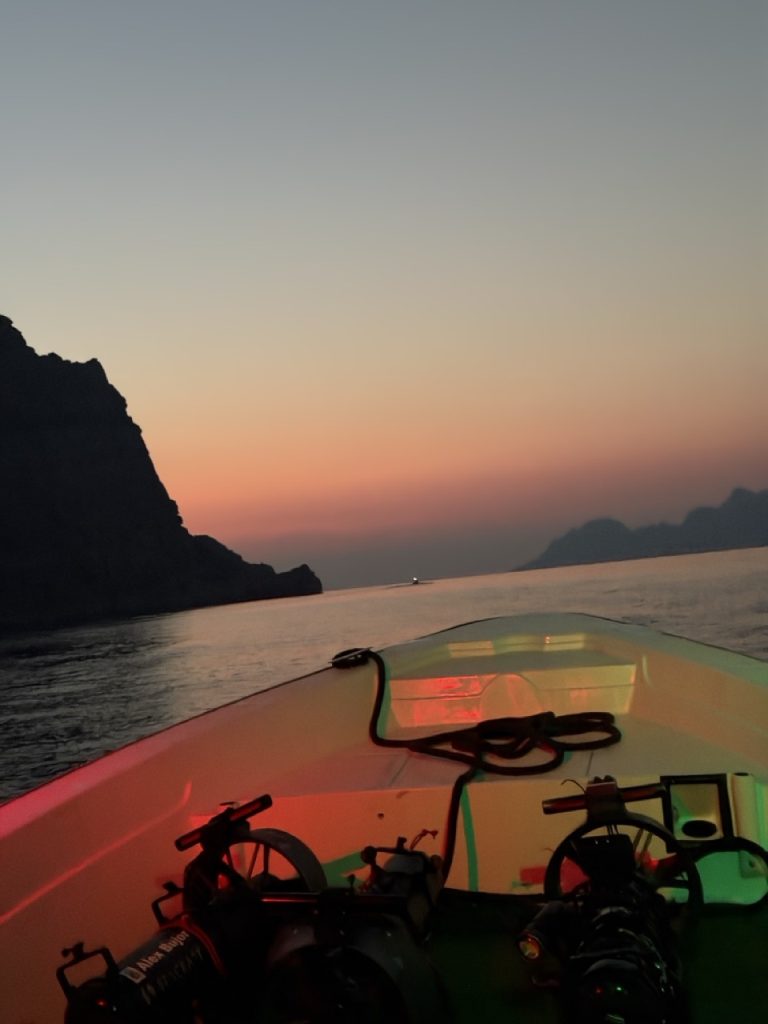
On the evening of 22 November 2026, we departed from the port of Dibba on the Omani side of the border, heading north along the Musandam Peninsula towards the waters of the Strait of Hormuz.
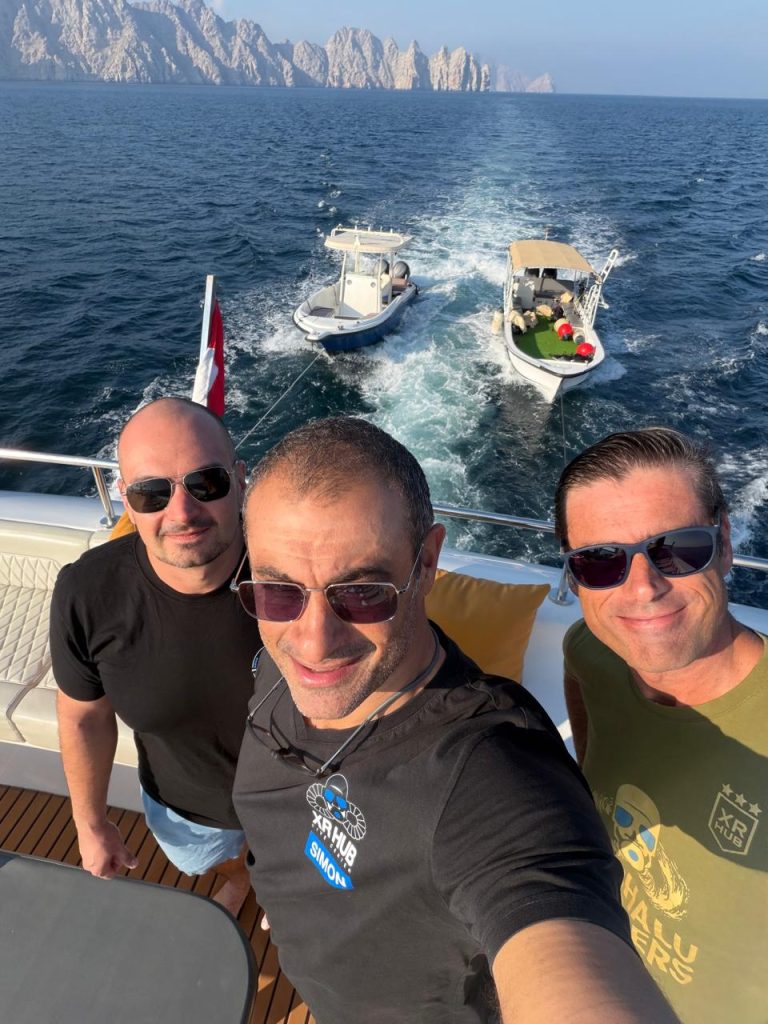
Our expedition was supported by three vessels, each serving a different purpose throughout the operation: a yacht that would serve as our main expedition base and accommodation, a fishing boat equipped with the sonar necessary to investigate the seabed and a dedicated diving boat from which we would conduct our underwater operations.
Having these three vessels at our disposal allowed us to combine the investigative capabilities required to locate the underwater structure with the logistical and surface support necessary for an exploration of this nature, particularly considering the offshore location and the anticipated duration of our dives.
As we travelled along the coastline of Musandam that evening, we knew that the following days would be largely dictated by what we discovered during our sonar surveys and by the environmental conditions at the site. Although considerable research and preparation had preceded our departure from Dibba, much of what lay ahead remained uncertain.
We spent the night aboard the yacht, enjoying a good night’s sleep before beginning our operations on the morning of 23 November.
23 November — The first encounter
At the northern extremity of the Arabian Peninsula, where the Gulf of Oman meets the Strait of Hormuz, lies one of the most historically significant maritime regions in the world. While above the surface some of the busiest commercial shipping routes connect the Persian Gulf with the Indian Ocean, beneath these waters lies an underwater landscape whose features and history remain, in many places, insufficiently documented.
On the morning of 23 November, our international team of three technical divers — Simon Nadim from Lebanon, Tobias O’Connell from the United Kingdom and myself, Alexandru Bujor, from Romania — began investigating a set of coordinates obtained from local fishermen, whose knowledge of the seabed suggested the presence of a possible shipwreck resting at a depth exceeding 110 metres.
Interestingly, some of the electronic nautical charts available to us represented the location as something resembling an underwater mountain, despite the surrounding seabed being relatively flat. Whether this representation originated from an incomplete hydrographic survey, an interpretation of older bathymetric data or another source of information remained unclear, but the discrepancy between the charts and the information obtained from the fishermen was sufficiently intriguing to justify an investigation.
Almost all the research behind this expedition had been carried out by Simon Nadim, owner of XRHub, whose extensive experience in locating, identifying and exploring shipwrecks has given him a remarkable understanding of the underwater environment.
Having spent a considerable amount of time diving and training alongside Simon, I have come to appreciate that his most exceptional qualities extend well beyond his technical abilities as a diver, impressive as those abilities are. His understanding of the ocean, his capacity to interpret underwater topography and maritime information and his almost intuitive feeling for what lies beneath the surface are, in my experience, unmatched. It is one thing to possess the technical competence necessary to reach a shipwreck at an extraordinary depth, but it is something altogether different to have the investigative instinct required to find it in the first place.
Our initial survey produced encouraging results. We established sonar contact with a structure rising from the surrounding seabed and successfully deployed an anchor and several buoys, establishing a physical reference for the subsequent exploration. Although we had not yet entered the water, we had already transformed a set of coordinates obtained from local fishermen into a tangible underwater target.
What remained uncertain, however, was the nature of the object itself.
Both Toby and I entertained the possibility that what we were seeing on the sonar might simply be a shipping container that had been lost overboard, a hypothesis that did not seem particularly unreasonable considering the extraordinary volume of commercial maritime traffic passing through the Strait of Hormuz. Simon, however, insisted that we were looking at something considerably larger than a container. Although neither Toby nor I could be entirely convinced without seeing the structure ourselves, Simon’s experience gave us every reason to take his interpretation seriously.
As we would discover the following day, he was right.
Despite the encouraging results of the survey, the strength of the current made it increasingly apparent that the conditions were unsuitable for the dive we had intended to conduct. At depths exceeding 100 metres, a powerful current is not merely an inconvenience, but an environmental factor capable of influencing almost every aspect of the operation, from the physical and respiratory workload of the divers to navigation, team cohesion and the management of an extended decompression.
Having assessed the conditions, we decided to cancel the dive and return to our yacht.
It would nevertheless be inaccurate to describe the first day as an unsuccessful attempt. We had established sonar contact, deployed the anchor and buoys and gained valuable firsthand knowledge of the environmental conditions at the site, all of which allowed us to approach the following day’s exploration with a considerably better understanding of what awaited us.
There was little reason to force an underwater operation simply because considerable time and resources had already been invested in reaching the location. The structure was not going anywhere. The experience of that first day allowed us to refine our approach, planning the following day’s dive around the high tide and the anticipated evolution of the currents throughout an operation that would keep us beneath the surface for several hours.
The only question that remained was whether the structure waiting for us at the bottom of the Strait of Hormuz would justify the considerable effort required to reach it.
24 November — Returning to the site
At 6:30 on the following morning, we left our main expedition yacht and headed towards the location we had surveyed the previous day. The sun had not yet risen sufficiently to provide the natural light we wanted for the beginning of the dive, so we waited as the morning gradually unfolded over the waters of Musandam, allowing the daylight to develop before committing ourselves to the descent.
Somewhere beneath us, at a depth where natural light becomes increasingly scarce and where relatively few divers ever venture, lay a structure whose origins and identity remained unknown. Despite the previous day’s sonar survey and Simon’s conviction that we had found something significant, the possibility that we might undertake an extraordinarily demanding dive only to discover a relatively unremarkable object had not entirely disappeared.
That uncertainty is, in many respects, an essential part of genuine underwater exploration. Unlike visiting a known shipwreck, where the diver can study its history, dimensions and structural characteristics before entering the water, an expedition of this nature begins with incomplete information. The considerable effort required to reach the target offers no guarantee that what lies there will correspond to one’s expectations.
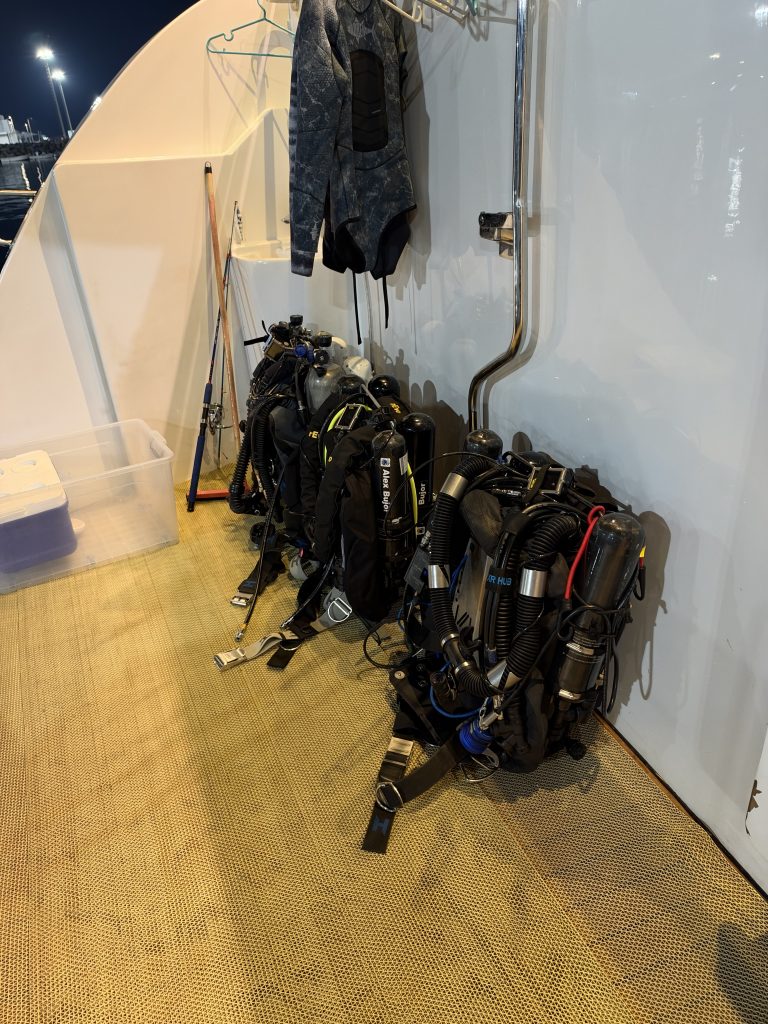
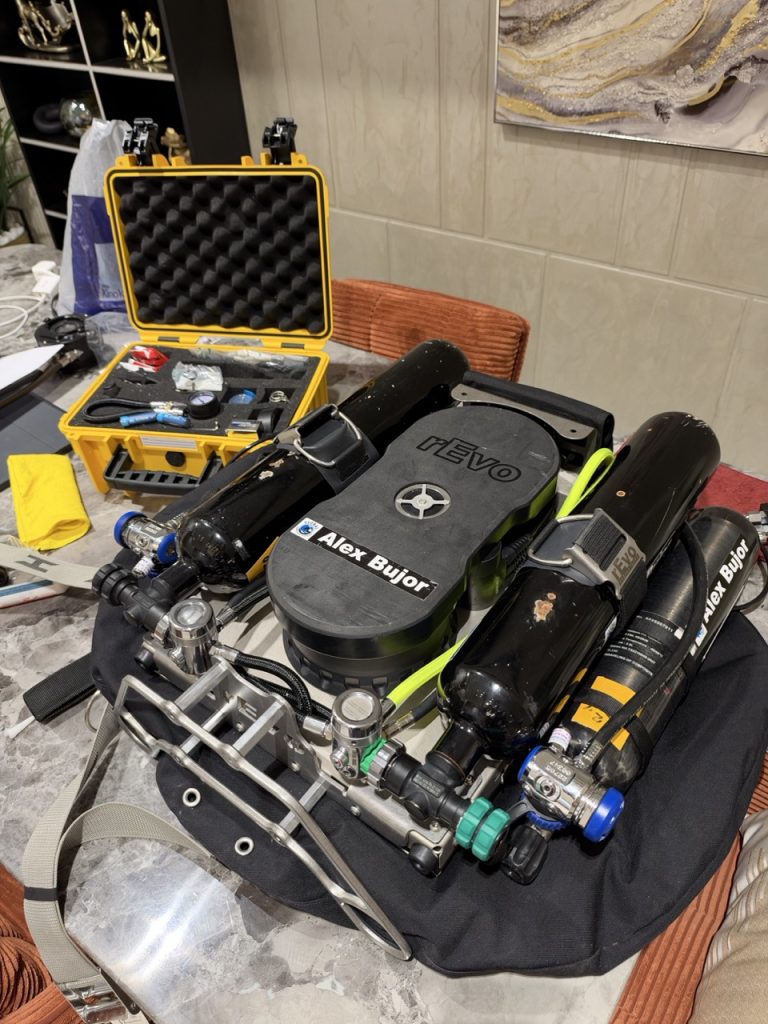
Our equipment and breathing gas configuration reflected the extreme depth of the planned exploration. The expedition relied on rEvo closed-circuit rebreathers, underwater propulsion vehicles, multiple bailout cylinders and specialised technical diving equipment. My breathing gas configuration consisted of Trimix 9/70 as diluent, with Trimix 10/65, Trimix 17/45, Nitrox 50% and pure oxygen as bailout gases.
At 115 metres, the ambient pressure reaches approximately 12.5 bar absolute. The physiological and technical considerations associated with breathing gases at such pressures become substantially more complex than those encountered during conventional recreational diving. Gas density, respiratory workload, oxygen partial pressure, inert gas absorption, equipment operating limitations and emergency contingencies all become interconnected elements of an operation in which reaching the seabed represents only a relatively small portion of the total underwater time.
The greater undertaking would be returning from it.
Entering the waters of Hormuz
The first indication of the conditions awaiting us came almost immediately after jumping into the water, when we realised that even with our underwater scooters operating at speed setting nine out of ten, we were barely able to overcome the strength of the current.
Anyone familiar with the power of a modern underwater propulsion vehicle will appreciate the significance of that observation, particularly when considering that we were still near the beginning of a dive that would take us to approximately 115 metres. There is something profoundly humbling about entering the ocean with sophisticated equipment specifically designed to provide mobility underwater, only to discover that almost its entire available power is necessary simply to resist the movement of the surrounding water.
The Strait of Hormuz is generally discussed in the context of international shipping, energy transportation and geopolitics, but experiencing its waters from the perspective of a diver offers an entirely different appreciation of the region. The movement of the water was not merely an obstacle to overcome on our way towards the seabed; it was one of the defining characteristics of the environment in which the entire expedition would take place.
Although we had planned the dive around the anticipated tidal conditions, we knew that this did not necessarily mean entering the water during a period of calm. The timing had to account for an operation lasting several hours, during which the conditions could evolve considerably between the initial descent and the final decompression stops.
With the current already demonstrating its strength, we began our descent towards the structure that had occupied our thoughts since the previous day’s survey.
115 metres beneath the surface
As we reached the seabed at approximately 110–115 metres, I encountered one of the known operating limitations of my rEvo rebreather configuration that we had taken into consideration during the preparation of the expedition.
At that depth, the unit was no longer delivering pure oxygen into the breathing loop. Even when attempting manual injection, I could hear that oxygen was no longer being introduced. This was not an unexpected mechanical failure, but an anticipated depth-related limitation of the particular configuration I was using.
Nevertheless, there is a considerable psychological difference between understanding an equipment limitation during the planning of an expedition and experiencing it while more than 100 metres beneath the surface of the ocean, particularly when the surrounding conditions are already demanding.
As anticipated, management of my breathing loop at this depth involved the use of diluent flushing, with continuous attention to the oxygen partial pressure. The lower oxygen partial pressure had a substantial influence on the decompression predictions displayed by my Shearwater dive computers.
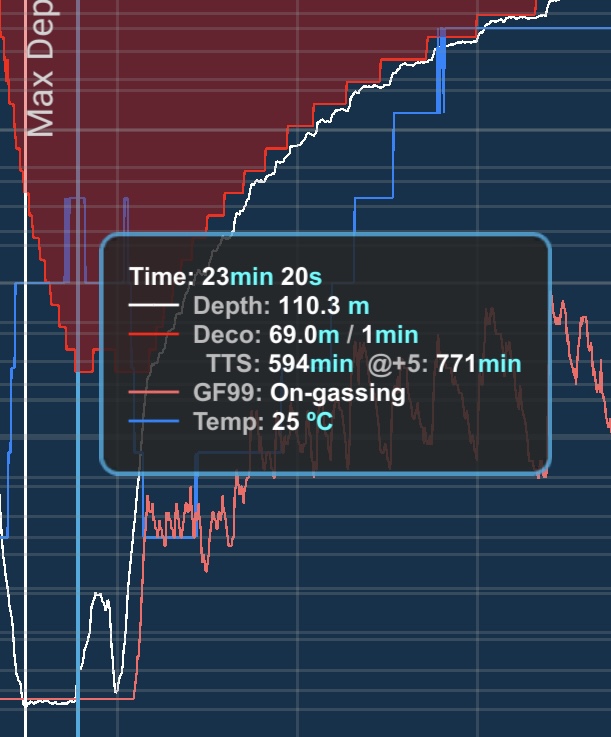
One of the most revealing moments captured in the dive profile recorded by my Shearwater NERD 2, which serves as my head-up display, occurred 23 minutes and 20 seconds after entering the water, when I was at a depth of 110.3 metres. At that particular moment, the computer displayed a calculated time to surface of 594 minutes, equivalent to nine hours and 54 minutes, while its predictive calculation for remaining at the same depth for another five minutes indicated a potential time to surface of 771 minutes, or nearly thirteen hours.
These figures were dynamic predictions generated by the decompression model under the prevailing conditions and its active assumptions, rather than the final decompression obligation of the dive. As the depth and oxygen partial pressure subsequently changed, so did the calculated time required to return to the surface.
Still, seeing a time-to-surface value approaching 600 minutes while more than 110 metres beneath the ocean is an experience that is difficult to adequately describe to someone unfamiliar with extreme technical diving. The numbers provide an immediate perspective on the physiological consequences of being at such a depth and the considerable influence that conditions inside a rebreather’s breathing loop can have on the predicted duration of an expedition.
While these circumstances had been anticipated, they remained a significant part of the reality of conducting an exploration in an environment where equipment operating margins, environmental conditions and human physiology converge in ways that deserve considerable respect.
Following Simon towards the wreck
Simon located the structure and we began following the line towards it, although the current remained sufficiently powerful at the seabed to complicate even relatively simple movements.
At one point, I was pushed against the line by the movement of the water, causing one of my fins to become entangled. Unable to free it immediately, I required assistance from Toby, who helped me release the fin before we could continue towards the wreck.
The incident was relatively brief, but its significance should not be underestimated. At a depth exceeding 110 metres, in a powerful current and with a substantial decompression obligation already accumulated, an entanglement that might otherwise be considered a relatively straightforward inconvenience takes on an entirely different character.
Toby’s assistance was a practical demonstration of the importance of teamwork during extreme-depth exploration, where the ability to recognise and respond to the difficulties encountered by another diver is just as important as the ability to manage one’s own equipment and responsibilities.
When we eventually reached the structure, the uncertainty that had accompanied us since the previous day’s sonar survey gave way to a sense of genuine excitement, as it became immediately apparent that what we were looking at was neither the underwater mountain represented on some of the electronic charts nor the shipping container that Toby and I had considered a possibility.
The structure was unmistakably man-made and considerably more complex than anything that could reasonably be associated with a lost container. Substantial metallic sections, valves and interconnected mechanical components appeared to form part of a ship’s structure, confirming that the object identified during our sonar survey was something considerably more significant than we had initially dared to assume.
What was particularly interesting was the absence of any natural underwater formation corresponding to the mountain represented on the electronic charts. Instead, the wreck appeared to be resting on a relatively flat seabed, providing yet another example of the discrepancies that can exist between the information available to us at the surface and the actual characteristics of the underwater environment.
I could not help but think back to our conversations on the previous day, when Simon had insisted that the sonar contact represented something much larger than a container. Finding myself more than 110 metres beneath the surface of the Strait of Hormuz, surrounded by the physical evidence of what he had anticipated, I once again found myself appreciating the remarkable investigative instinct that he brings to underwater exploration.
There is a considerable difference between identifying an anomaly on a sonar display and understanding what that anomaly might represent, particularly in an environment where the opportunity to visually investigate it requires an expedition of this magnitude.
Simon had been right. The satisfaction of finally seeing the structure with our own eyes was amplified by the uncertainty that had preceded the discovery.
A piece of maritime history
Among the most interesting characteristics of the wreck was the condition of some of its metallic structures, which appeared to have undergone considerable deformation. Certain components that seemed to have originally possessed regular, rounded or oval shapes had been distorted into irregular forms, giving the impression that they might have been exposed to intense heat at some point before the vessel sank.
We observed valves and other mechanical components connected within a larger metallic structure, providing further indications that we were exploring what appeared to be part of a ship rather than an isolated object that had been lost overboard.
Although the condition of the metal raised the possibility that the vessel had experienced a significant fire before sinking, establishing the cause of the deformation and its relationship to the loss of the vessel will require further investigation.
The historical context of the Strait of Hormuz, particularly the maritime incidents associated with the Tanker War of the 1980s, provides several interesting avenues for research. During that period, which formed part of the broader Iran–Iraq War, commercial vessels navigating the waters surrounding the Arabian Peninsula became targets in a conflict that extended far beyond the territorial boundaries of the two countries directly involved.
Our initial observations have already provided us with a number of clues regarding what the particular section of the wreck we encountered might represent. We have begun developing hypotheses based on its structural characteristics and the available historical information.
At this stage, however, we prefer not to speculate publicly about the identity of the vessel or draw conclusions that cannot yet be supported by sufficient physical and historical evidence. Establishing a reliable identification will require several additional dives, more comprehensive photographic documentation and a detailed examination of the structural and mechanical features present at the site.
Once we have gathered sufficient evidence to establish a clear identification, we intend to publish our findings, together with the observations and research that have led us to our conclusions.
Nevertheless, there was something profoundly rewarding about seeing the structure with our own eyes, knowing that the information obtained from local fishermen, the investigative work carried out by Simon and the previous day’s sonar survey had ultimately led us to what appeared to be a genuine piece of maritime history.
For a moment, the excitement of discovery gave a different meaning to the depth, the current and the enormous decompression figures displayed on our computers. The depth was no longer merely a number; it was the distance that had separated us from something we had wanted to understand.
Leaving something behind
While attempting to capture underwater footage of the wreck, I lost one of my orientation strobes, a small flashing light of the type we normally deploy on a line to provide a visual reference during underwater exploration.
As I watched it descend beyond my position, I realised that recovering it would have required me to go deeper, unnecessarily extending my exposure at depth and potentially adding further minutes to an already considerable decompression obligation.
Under ordinary diving circumstances, retrieving a relatively inexpensive piece of equipment might have been an almost instinctive reaction, but at approximately 115 metres, where even small changes in depth and exposure time can have meaningful consequences for the subsequent ascent, the decision was remarkably straightforward.
I simply allowed it to disappear beneath me and continued with the dive.
For those of us who approach underwater exploration with a strong interest in photography and cinematography, moments such as this provide a valuable reminder that the desire to obtain footage, recover equipment or document an additional feature of a wreck must always remain subordinate to the requirements of the dive itself.
The strobe was replaceable, whereas the additional exposure required to recover it would have contributed nothing meaningful to the objectives of our expedition.
Somewhere on the seabed of the Strait of Hormuz, there is now a small orientation strobe that has inadvertently become part of the story of our first exploration of this wreck.
Three hundred minutes to the surface
As we left the wreck and began our ascent, I looked at my dive computer and saw that the calculated time to surface had settled at approximately 300 minutes.
Although this represented a considerable reduction from the predictions I had observed at the seabed, the number still meant that approximately five hours of ascent and decompression separated us from the surface, despite the fact that the principal exploration objective of the expedition had already been accomplished.
For someone unfamiliar with technical diving, this is perhaps the most difficult aspect of an expedition of this nature to fully comprehend. During a conventional recreational dive conducted within no-decompression limits, a diver can generally initiate a controlled ascent to the surface whenever circumstances require it. During an extreme-depth technical dive, however, the absorption of inert gases into the body’s tissues creates what is known as a physiological overhead environment, in which a direct ascent to the surface could have potentially catastrophic consequences.
The ocean above us, although physically traversable, had effectively become a barrier that could only be crossed gradually, allowing our bodies time to release the inert gases accumulated during the descent and the time spent exploring the seabed.
There is a particular psychological dimension to spending several hours underwater once the excitement of the exploration has ended. The anticipation associated with discovering an unidentified wreck gradually gives way to a much quieter experience, in which the passage of time becomes almost tangible and the numbers on the dive computer acquire an unusual importance.
I remember patiently waiting for the first hundred minutes to disappear from the display, then waiting for the second hundred, until eventually the remaining time to surface could once again be expressed using only two digits. Each of these milestones provided a small sense of progress during an ascent whose duration was considerably greater than the time we had spent reaching and exploring the wreck.
Throughout this process, the equipment continued to require attention, the surrounding environment had to be monitored and the cohesion of the team remained important, even as the physical demands of the dive gradually shifted towards the mental discipline required to complete such an extended period of decompression.
It is an aspect of expedition diving that receives considerably less attention than photographs of divers exploring spectacular wrecks at extraordinary depths, yet it represents the overwhelming majority of the time spent underwater during many of these expeditions.
Reaching a depth of 115 metres may be the most spectacular element of the dive when viewed from the outside, but spending the following five hours underwater, patiently working towards the surface, is an equally defining part of the experience.
A moment of humour beneath the surface
One of the most memorable moments of the entire expedition occurred not at 115 metres, nor while we were exploring the wreck, but during the long hours of decompression, somewhere around our nine- or six-metre stops.
Simon approached Toby and me to ask whether we were both okay, to which we responded that everything was fine.
Simon, however, had a rather different assessment of our condition. With his characteristic sense of humour, he indicated that we were not okay at all, because the mere fact that we had agreed to undertake such a dive was sufficient evidence that all three of us were crazy.
After everything we had experienced during the preceding hours, there was something particularly amusing about this exchange taking place while we were still underwater, patiently waiting for our computers to allow us to return to the surface.
It was also a reminder that behind the sophisticated equipment, the decompression calculations, the extensive training and the seriousness with which we approached the expedition were three individuals who shared a rather unusual passion for exploring the underwater world and who were still capable of appreciating the absurdity of their situation.
From an outsider’s perspective, the idea of voluntarily spending nearly five and a half hours underwater, most of them simply waiting to be able to surface, in order to investigate a structure that might have turned out to be a shipping container, probably does require a certain explanation.
For the three of us, however, the experience of having reached the wreck and seen something that had previously existed only as an uncertain sonar contact provided an answer that was difficult to express in conventional terms.
Simon’s observation was perhaps one of the most entertaining summaries of the expedition. It remains among the moments I remember most fondly from those seemingly endless hours of decompression.
When the ocean changes
During the latter part of our decompression, the strength of the current gradually diminished until, for a period, the surrounding water became almost entirely calm.
The evolution of the conditions was remarkably consistent with the tidal timing we had taken into consideration when planning the expedition, particularly after the experience of the previous day. Having entered the water while the current was still sufficiently strong to challenge almost the entire available power of our scooters, we were now experiencing a completely different underwater environment, despite remaining in the same geographical area.
From our perspective, the timing of the dive had worked remarkably well. Experiencing this gradual transformation of the surrounding water provided yet another appreciation of the importance of understanding the ocean rather than simply possessing the equipment necessary to operate within it.
Eventually, however, the current began to shift again. With approximately 50 minutes of decompression remaining, the line from which we were conducting our ascent became slack.
Maintaining a stable position became increasingly awkward and we eventually found ourselves negatively buoyant in order to maintain tension on the line, completing the final part of our decompression essentially hanging from it.
There was something almost amusing about the contrast between our appearance at that moment and the carefully composed illustrations of technical divers maintaining perfect horizontal trim in diving textbooks. After several hours underwater, in an environment that had already challenged our equipment, physical capabilities and patience, the final picture of our expedition was considerably less elegant than one might imagine when reading about the principles of advanced technical diving.
Had someone photographed us at that particular moment, the resulting image would probably not have been selected to illustrate ideal trim and buoyancy control in a technical diving manual. It would, however, have provided a rather authentic representation of the circumstances that can arise during an extended offshore expedition, when the conditions encountered in the ocean no longer resemble those in which many of the techniques of technical diving are initially taught and practised.
The ocean, of course, is entirely indifferent to the illustrations in our training manuals.
Our position on the line was a response to the particular circumstances we encountered, rather than a technique we would present as a preferred method of decompression. It remains one of several elements of the expedition that deserve consideration when reviewing the dive and preparing for future explorations.
At that stage, after having already spent several hundred minutes underwater, the remaining 50 minutes represented a relatively small portion of the entire operation, although they seemed to pass considerably more slowly than one might have expected.
Five hours and 24 minutes later
Eventually, five hours and 24 minutes after entering the water, we finally surfaced in the Strait of Hormuz.
There are moments during an expedition when the significance of what has been accomplished becomes apparent almost instantaneously. For me, this was one of them. The experience of the previous day’s sonar survey, the decision to cancel the first dive, the early morning departure from our yacht, the powerful currents, the descent to 115 metres, the first observations of the wreck and the seemingly endless hours of decompression suddenly became part of a single, completed experience.
As we made our way back to the expedition yacht, I felt an extraordinary sense of satisfaction, not simply because we had reached a depth that represents a considerable technical achievement, but because we had reached it with a genuine purpose and had accomplished what we had travelled there to do.
Only a day earlier, Toby and I had been discussing the possibility that the object we were about to investigate might be nothing more than a shipping container, while Simon had remained convinced that the sonar contact represented something considerably more significant. We had now seen the structure with our own eyes and could return with observations that would form the basis of the next stage of the investigation.
The research had led to a set of coordinates, the coordinates had led to an underwater structure identified through sonar and the structure had ultimately revealed itself to be what appeared to be the remains of a ship whose identity remains to be established.
All the preparation, training, equipment, logistical arrangements and hundreds of minutes spent underwater had been directed towards answering a question that could not be resolved from the surface alone.
Returning to the yacht, knowing that all three of us had completed the dive and that we had obtained meaningful observations of the site, made the entire effort feel worthwhile. It is difficult to reproduce that particular feeling through photographs, dive profiles or technical descriptions, because it is the culmination of everything that precedes such an expedition, including the uncertainty of the research, the preparation, the decisions made along the way and the experience of finally reaching a place that, until then, had existed for us only as a set of coordinates and an image on a sonar display.
Perhaps Simon had been right about us being a little crazy, but as we returned to our yacht that afternoon, having spent a considerable part of the day beneath the waters of the Strait of Hormuz, I could think of few other experiences that could have provided the same sense of accomplishment.
Understanding the scale of the expedition
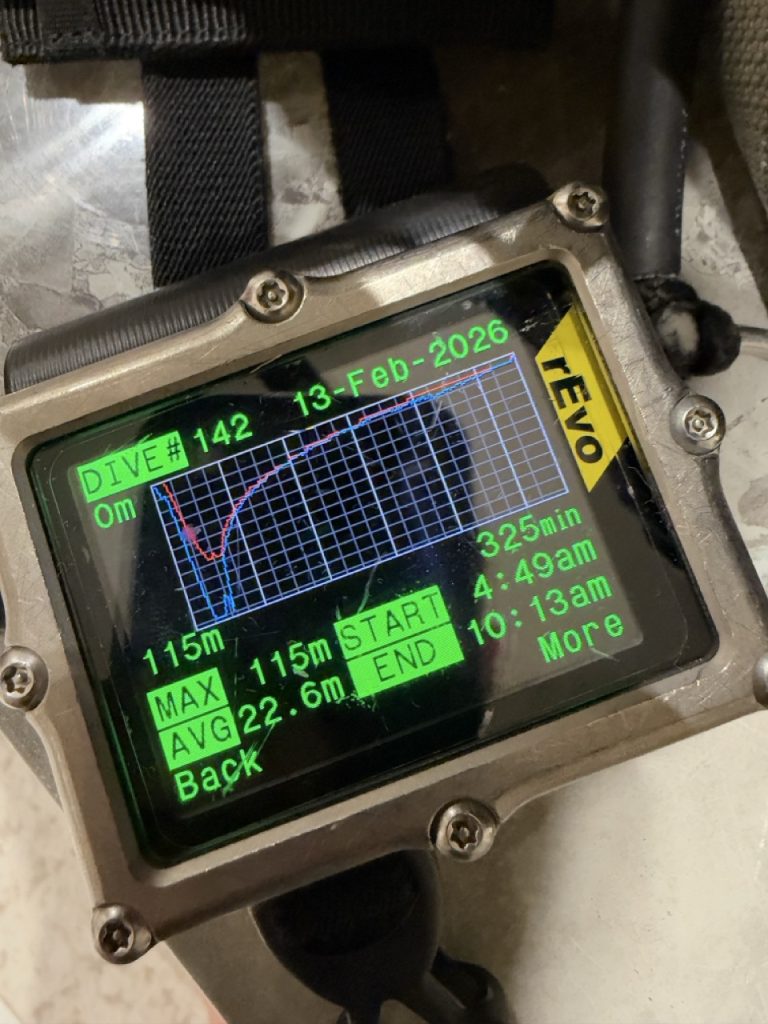
My dive was documented using two Shearwater dive computers: the Shearwater NERD 2, which serves as my head-up display (HUD), and the Shearwater handset of my rEvo rebreather. Both devices recorded closely corresponding maximum depths, average depths and total underwater runtimes.
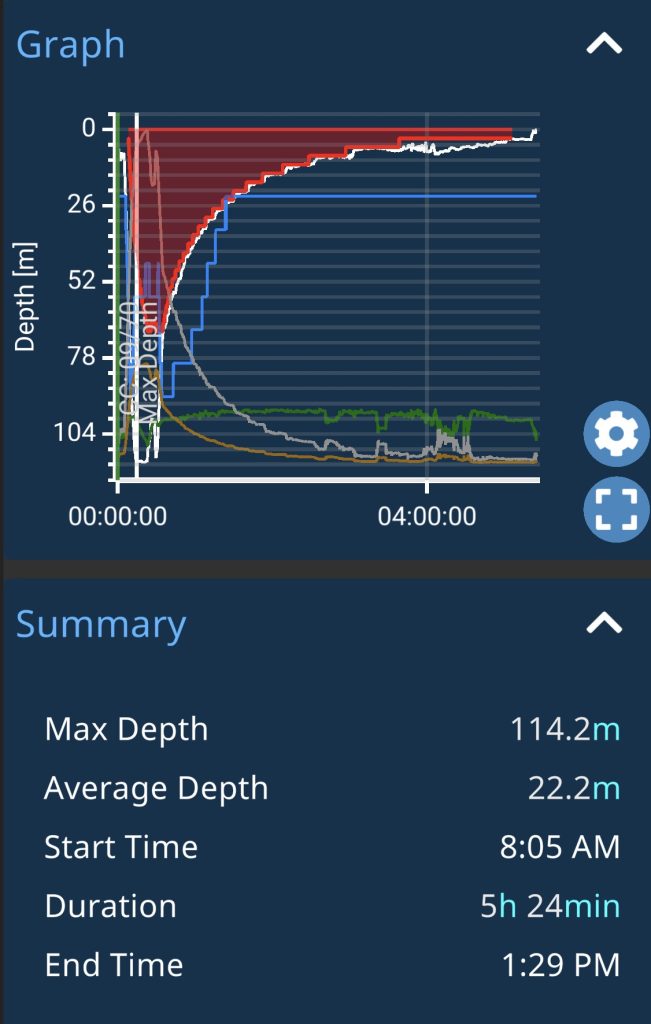
The complete dive profile presented in this article was recorded by the Shearwater NERD 2 and subsequently downloaded into the Shearwater application, where the evolution of the dive can be examined in greater detail.
| Recorded parameter | Shearwater NERD 2 (HUD) | rEvo Shearwater handset |
|---|---|---|
| Maximum depth | 114.2 m | 115 m |
| Average depth | 22.2 m | 22.6 m |
| Total underwater runtime | 324 minutes | 325 minutes |
Expedition data
| Parameter | Configuration |
|---|---|
| Expedition departure | Evening of 22 November 2026 |
| Port of departure | Dibba, Sultanate of Oman |
| Preliminary sonar survey | 23 November 2026 |
| Exploration dive | 24 November 2026 |
| Departure from the main yacht on dive day | 06:30 local time |
| Location | Strait of Hormuz, Musandam, Omani waters |
| Expedition divers | 3 |
| Expedition vessels | 3 |
| Main expedition base | Yacht |
| Sonar survey vessel | Fishing boat equipped with sonar |
| Diving operations vessel | Dedicated diving boat |
| Maximum recorded depth | 115 metres |
| Total underwater time | Approximately 5 hours and 24 minutes |
| Rebreather platform | rEvo CCR |
| Dive computers | Shearwater NERD 2 HUDm rEvo Shearwater handset, Halcyon Symbios offboard |
| Diluent | Trimix 9/70 |
| Bailout gases | Trimix 10/65, Trimix 17/45, Nitrox 50%, Oxygen 100% |
| Underwater propulsion | Seacraft DPVs |
| Ambient pressure at maximum depth | Approximately 12.5 bar absolute |
| Recorded water temperature at 110.3 m | 25°C |
| Exploration objective | External investigation of an unidentified shipwreck |
| Wreck penetration | None |
| Identification status | Ongoing investigation |
To put the depth of this expedition into perspective, a recreational diver descending to 30 metres experiences approximately four times atmospheric pressure at sea level, whereas at 115 metres the ambient pressure reaches approximately 12.5 times atmospheric pressure. However, the difference between these two dives cannot adequately be expressed as a simple multiplication of either depth or pressure, since the physiological, technical and logistical requirements of extreme-depth diving increase in a considerably more complex manner.
A recreational diver at 30 metres, provided that the dive remains within no-decompression limits, is generally only a few minutes of controlled ascent away from the surface. During our exploration in the Strait of Hormuz, there was a moment when my dive computer predicted that nearly ten hours separated me from the surface, despite the physical distance above me being only slightly greater than the length of a football pitch.
This distinction is fundamental to understanding extreme technical diving, because the difficulty of the operation is determined not merely by the distance travelled underwater, but by the physiological consequences of spending time at elevated ambient pressures and the resulting inability to return directly to the surface.
The recorded average depth of approximately 22 metres, despite a maximum depth of 115 metres, is particularly illustrative of the nature of this expedition, demonstrating how much of the total runtime was spent at progressively shallower depths during the prolonged ascent and decompression.
Unlike a conventional recreational dive, an expedition of this nature becomes an extended underwater life-support operation, requiring the management of equipment, breathing gases, environmental conditions and human performance over a period that may exceed the duration of many other demanding physical activities.
The maximum depth is perhaps the easiest parameter to communicate, but it is far from being the only one that defines the complexity of the achievement.
Exploration beyond the numbers
What makes an expedition of this nature meaningful is the combination of investigative work, technical competence, environmental understanding, logistical preparation and collaboration that ultimately allows us to reach and investigate a location that would otherwise remain inaccessible.
Although the maximum depth and total underwater runtime provide a useful indication of the complexity of the operation, they reveal relatively little about the investigative process that preceded it, the decisions that had to be made throughout its duration or the significance of what we encountered on the seabed.
The expedition provided valuable material for further technical analysis, from the strength and evolution of the currents to the management of anticipated equipment limitations, the entanglement incident and the circumstances encountered during the final decompression stops. Completing an expedition successfully does not eliminate the need to critically examine the decisions made throughout its duration; on the contrary, such an examination is what allows the experience to contribute meaningfully to future exploration.
Looking back at the expedition, the decision not to dive on 23 November deserves as much recognition as the decision to undertake the exploration on 24 November. Both were part of the same process of understanding the environment, assessing the circumstances and determining whether the conditions justified proceeding with the expedition.
For us, the ultimate objective is not depth itself, but what depth allows us to discover. There is a fundamental difference between descending to 115 metres simply to demonstrate that it is possible and descending to that depth because something lies there that we genuinely wish to understand.
In this particular expedition, the depth was dictated by the location of the structure we wanted to investigate. Had the same wreck been resting at 50 metres, the historical questions surrounding it would have been no less interesting, even though the technical requirements of reaching it would have been considerably different.
It is this distinction between depth as an objective and depth as a consequence of an exploration objective that lies at the heart of our approach to expedition diving.
An investigation far from complete
Our first exploration of this site has provided answers to some of our initial questions while opening several others. We now know that the structure we investigated is neither a natural underwater mountain nor the shipping container that Toby and I had initially considered a possibility. The observations made during the dive have already provided us with several clues regarding the nature of the wreck and the particular section we encountered.
Nevertheless, the work required to establish its identity is far from complete. We will need to return to the site and conduct several additional exploration dives, gathering more extensive visual documentation and examining features that may allow us to establish a reliable connection between the physical remains on the seabed and the historical records of vessels lost in these waters.
Given the depth of the site and the environmental conditions we encountered during our first expedition, each subsequent exploration will represent a considerable undertaking in its own right. The limited amount of time that can reasonably be spent investigating the structure during a single dive means that establishing its identity may become a gradual process, with each expedition contributing another piece of evidence towards a more complete understanding of the wreck.
In the meantime, the research will continue at the surface, where the observations made during our first dive can be examined in greater detail and compared with the available historical and technical information.
When we have sufficient evidence to establish a clear identification, we will publish our findings and hopefully reconstruct at least part of the story of how this vessel came to rest beneath the waters of Musandam.
There is something particularly rewarding about leaving an expedition with more questions than answers, especially when those questions provide a compelling reason to return. What began with information obtained from local fishermen, an uncertain sonar contact and a discussion about a possible shipping container has developed into an ongoing investigation of a piece of maritime history resting at an extraordinary depth.
Our first dive to the wreck lasted five hours and 24 minutes, but the exploration itself is far from over.
Somewhere beneath the waters of the Strait of Hormuz, 115 metres below the surface, there is a story waiting to be told and we intend to return to discover it.
Expedition team
Simon Nadim — Lebanon
Owner of XRHub, principal expedition researcher and technical diver.
Tobias O’Connell — United Kingdom
Technical diver and expedition team member.
Alexandru Bujor — Romania
Technical diver and expedition team member.